.png)

.svg)


AI impact on engineering roles and hiring practices
Insights from our internal research and conversations with engineering leaders at top tech companies.
.svg)

As we build R&D teams for tech companies, we’re seeing the AI shift move beyond daily development into team structure, hiring, and engineering expectations.
To make sense of it, we spoke with our customers and looked at how their approaches are changing. Despite differences in size and stage, the same signals kept appearing:
- leaner teams
- shifting role expectations
- shorter planning cycles
- a preference for engineers who can integrate AI into the full engineering workflow
We’ve put all of our observations together in this guide to give you a comprehensive view of the future for software engineers and illustrate how AI changes engineering recruiting.
Hiring is becoming more selective

One of the most widespread patterns we’ve observed is that hiring itself is becoming more deliberate, which is reshaping what works in tech recruitment. So, before opening a new role, decision-makers are no longer asking only who they need. The question increasingly becomes whether they need to hire at all or whether the work can be handled by AI.
If a team plans to open two or three new positions, they first need to justify why AI cannot cover that need.
This has led to very concrete outcomes. Roles are postponed or never opened, initial hiring plans are reduced, and teams rely more on AI-supported workflows instead of expanding headcount.
At the same time, our customers noted that planning itself has become shorter. Given how quickly AI capabilities evolve, many teams are no longer planning hiring beyond 1-2 quarters ahead.
But overall, this doesn’t look like an aggressive reduction in hiring. It looks more like a shift toward highly selective and justified hiring where every new role needs a clear reason to exist.
Demand is shifting toward more senior and context-driven roles
We’re seeing increased interest in roles such as:
- senior engineers who can operate independently
- specialists in complex domains such as data, cybersecurity, and large-scale systems
- engineers who can design and manage AI workflows and infrastructure
There is also a growing preference for more versatile profiles like engineers who combine strong technical foundations with product thinking and the ability to work across the stack.
Another important layer is emerging around AI economics. Some of our customers specifically mentioned the need for specialists who understand how to work with different models efficiently, from optimizing token usage to designing cost-effective infrastructure.
The pressure on junior and repetitive roles is increasing
We’ve chosen to highlight this AI impact on developers separately because it’s a sensitive but real dynamic that directly affects how to hire developers today. Companies are becoming more cautious about hiring for roles where the main value is task execution rather than judgment, ownership, or domain expertise. This does not mean that junior roles disappear overnight. But the threshold for hiring them is becoming higher.
Across teams, junior engineers are now expected to come in with a certain level of familiarity with AI tools, move more quickly across tasks, and operate with less supervision. This pattern also extends to manual QA, BI, basic data analysis, and maintenance-heavy roles, which are among the first to be reshaped due to their structured and repeatable nature.
👆So far, we’ve explored how AI changes engineering recruiting and what this means for team structures and hiring decisions.
👇 The next question we want to touch upon is the AI impact on software development processes and what the future of software engineers and teams might look like.
AI adoption is no longer limited to individual developer productivity
Across the companies we spoke with, AI is becoming embedded into the execution layer of engineering and gradually expanding into business functions. It is used to write or refactor code, support testing, debugging, reviews, maintenance, internal support, and smaller product changes.
The more important shift is that teams are starting to rethink which types of work require human execution at all. Repetitive fixes, support cases, debugging flows, QA-related tasks, and operational processes are increasingly treated as areas where agents can take on the first pass, while engineers provide context, supervise the output, and remain responsible for judgment and final decisions.
In this sense, AI is becoming less of a tool category and more of an organizational capability: something that changes how work is distributed, how teams plan capacity, and where human expertise is expected to create value.

Being AI-native is now the baseline
Another AI impact on developers that comes through is how expectations toward engineers are evolving. Comfort with AI tools such as Cursor, GitHub Copilot, Claude, and various agent-based setups is increasingly expected as part of everyday work. Teams assume that engineers are able to use these tools effectively without requiring dedicated onboarding from scratch.
What’s more, several of our customers mentioned that the ability to iterate quickly with AI and vibecoding is now part of what they look for in the hiring process. One example that came up was a data engineering candidate who had strong technical fundamentals but limited experience working in this way, which affected how far they progressed.
What stands out here is not the tools themselves but the way of working behind them. Teams are looking for engineers who are comfortable experimenting, adjusting their approach, and integrating AI into their daily workflow as a natural extension of their skills.
The role of the engineer is evolving toward orchestration
As AI takes over more of the execution layer, the role of the engineer is gradually evolving and getting more versatile and that is one of the most visible technology trends shaping modern development teams.
From what we have observed in conversations with our customers, now there is more focus on:
- structuring problems
- guiding AI tools
- reviewing and validating output
This is often described as a move from execution to orchestration. Nowadays, engineers are expected to manage workflows, coordinate multiple tools or agents, and oversee the overall process. In that sense, they act less like individual contributors in the traditional sense and more like coordinators of a system that produces output.
Smaller and more autonomous teams are becoming the new normal
In many of the teams that we’ve spoken with, there is a shift toward smaller and more focused squads. So, for instance, work that used to be distributed across a larger team of 8-10 people is now handled by 2-3 engineers who stay much closer to the full lifecycle of what they are building.
According to our customers, the reasoning behind this is fairly straightforward. Instead of expanding teams to keep up with growing backlogs, companies are focusing on increasing what each individual can realistically deliver. And AI plays a significant role here, taking on a substantial share of execution and allowing fewer people to cover more ground.
Engineers in such setups tend to operate across a wider scope, rely less on handoffs, and stay involved from idea to release. It requires more comfort with ambiguity, yet it also removes a lot of the coordination overhead that comes with larger and segmented teams.
New roles are emerging around AI itself
Another pattern that we observed is the emergence of an entirely new layer of roles focused on enabling AI to work more effectively with engineering teams.
Teams increasingly need engineers who can build the infrastructure for AI use, i.e., test environments, agent workflows, and systems for reviewing, validating, and deploying AI-generated code.
In some cases, this goes further, with companies deliberately building internal infrastructure such as shared knowledge bases, MCP integrations, and systems for managing model interactions and optimizing token usage.
We already see open positions like:
- AI enablement engineer
- agent infrastructure engineer
- AI workflow owners
- AI platform engineers
Soft skills are becoming core to engineering roles
Technical expertise, undeniably, remains essential, yet on its own it is no longer sufficient.
Across multiple companies, we’ve seen increasing emphasis on qualities that were previously considered secondary, like clear communication, the ability to structure thoughts, and comfort working across product and engineering boundaries. Engineers today are also expected to switch context more easily, understand the business side of what they are building, and take ownership beyond a narrowly defined scope.
Plus, there is a focus on curiosity and experimentation. Some teams explicitly look for engineers who are eager to actively explore new tools, push their limits in working with AI, and continuously adapt their workflows. In that sense, for employers/decision-makers, traits like energy and self-direction directly impact how effectively someone can operate in an AI-driven environment.
What fellow engineering leaders are saying about the AI shift
%20(3).png)
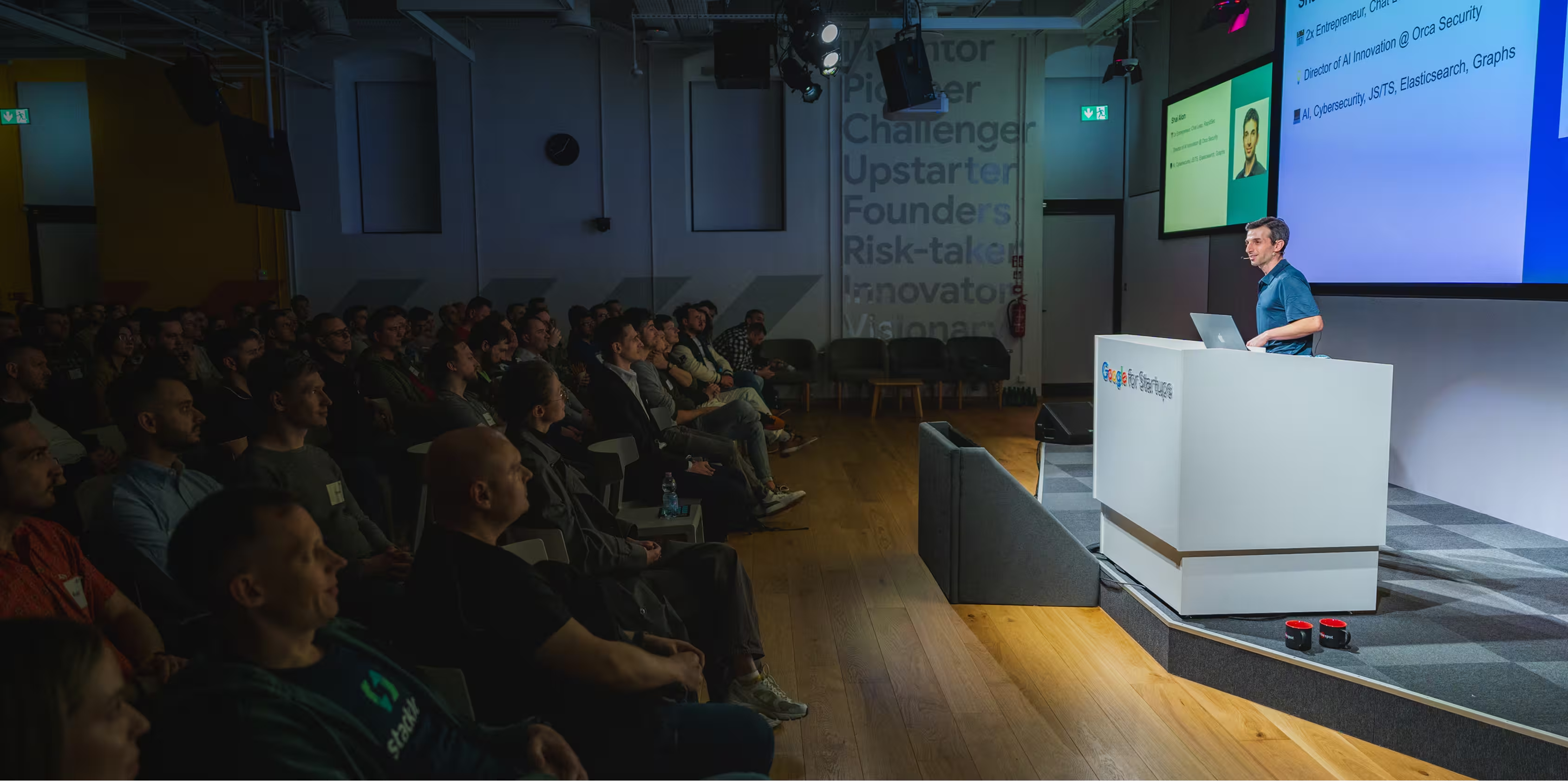
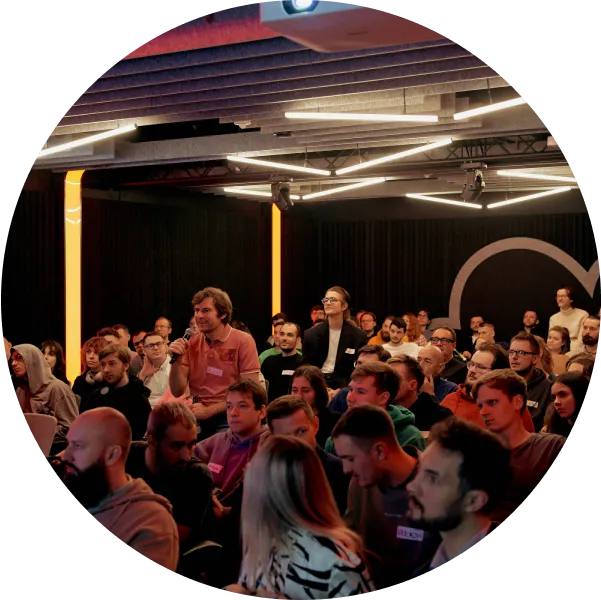
On April 9, we brought together 70+ engineering leaders, including CEOs, CTOs, and senior engineers from 50+ companies of different sizes at our TechSpot event in Warsaw. We discussed how AI is being adopted across both engineering and organizational systems and how teams are adapting their ways of working in response.
Throughout the talks and roundtables, we kept circling back to the same idea: when it comes to AI adoption, there aren’t established best practices yet, only first practices. Teams are figuring things out as they go, learning by doing and rebuilding assumptions as they move forward. Nothing feels fully settled or standardized yet and even the same problems are being solved in very different ways depending on context, maturity, and constraints.
There’s no playbook to follow, so teams are writing it in real time. In that sense, everyone building with AI today is a kind of trailblazer because there’s no other way to move forward right now. And maybe what feels experimental today will eventually become the foundation others build on, once the patterns start to settle.
Further listening
We also spoke with Boaz Adato from HoneyBook on our new episode of #137podcast. He shared their AI journey from early GPT experiments in late 2022 to a stage where AI tools are now part of everyday work across most teams.
Together with Boaz, we discussed how they approach tool experimentation, engineering metrics, the uneven impact of AI across new and legacy systems, and how workflows and team autonomy are evolving in practice. You can listen to the full episode on YouTube for more insights.
Closing thoughts
The operational model is changing. Planning horizons are getting shorter, adaptability becomes a core requirement, and a new layer of infrastructure forms around AI work, including rules, guardrails, and control points that support reliability at scale.
And surely engineering systems are becoming less dependent on large numbers of narrow roles and are more based on small and autonomous teams. In this setup, work happens through orchestration, review, and active management of AI-driven processes rather than direct execution.
If you’re adapting your engineering organization to the AI shift and need support with building a dedicated R&D team, hiring AI-ready engineers, or strengthening technical leadership, get in touch with us and we’ll be happy to assist you with that.
.webp)

Stay in tune
with On The Spot
You've successfully signed up for our newsletter. Keep an eye on your inbox.
Read more
Discover what else is happening at On The Spot
TechSpot
Tech events in Poland and online for everyone interested in software architecture and systems design. Like-minded people, top experts from leading companies, and a big engineering community.
%201%402x.svg)
%201.svg)
137 Podcast
Conversations with top engineers, CTOs, and founders about day-to-day engineering and everything that excites us about tech.


.svg)