.png)

.svg)


After prompts and context: the next shift in AI-native engineering
Key takeaways from TechSpot Core discussions
.svg)

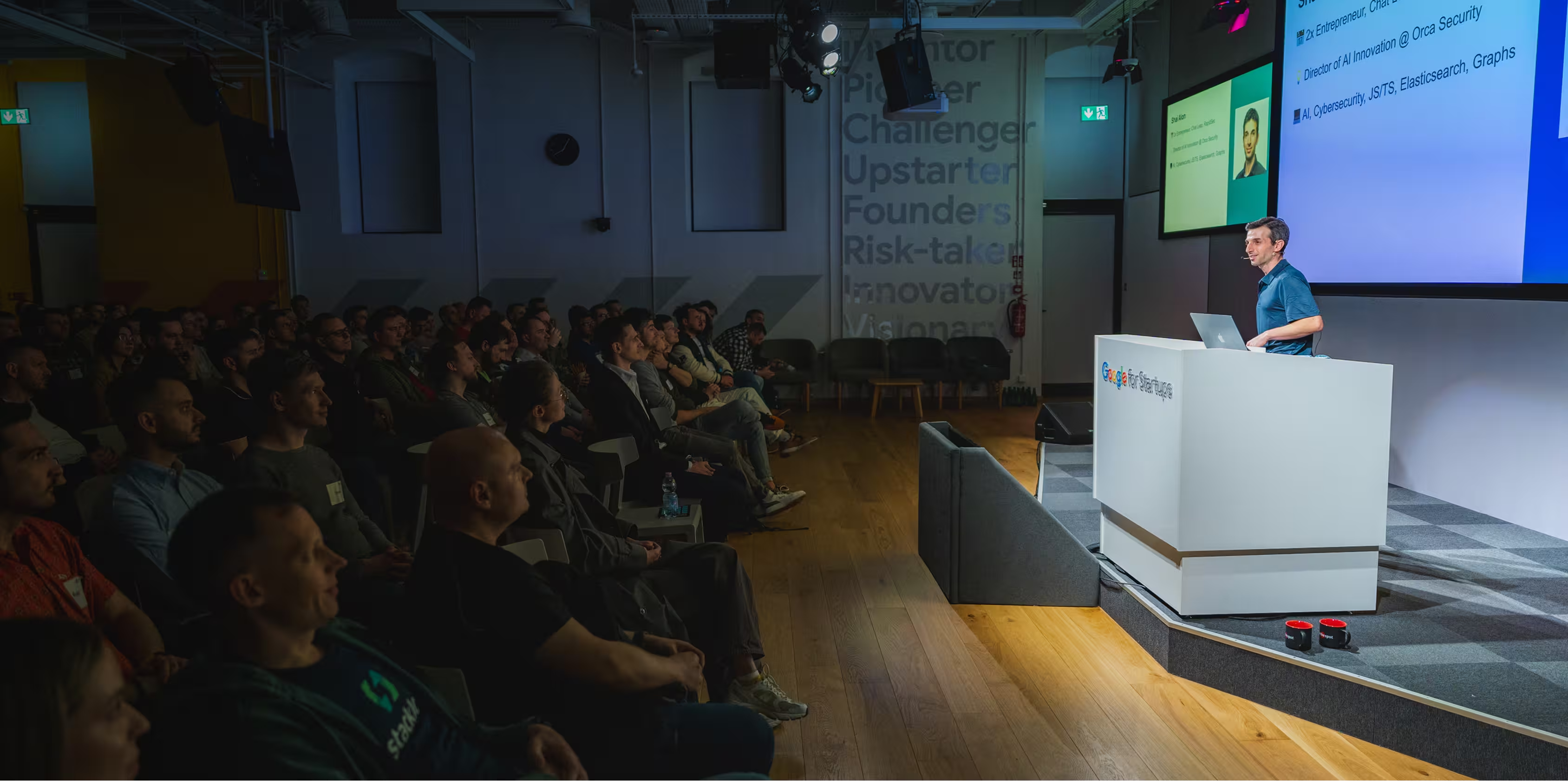
In April 2026, we hosted a special TechSpot Core conference in Warsaw for engineering leaders. The event brought together engineering leaders from more than 50 companies to exchange experiences around one of the biggest shifts currently affecting software teams.
In this article, we revisit some key ideas from the evening’s two keynote sessions:
1. New approach to engineering for AI-native system design
2. AI agents as an operational layer for software development.
[fs-toc-h2]Method or loop engineering for AI-native system design
[fs-toc-omit]1. Method or loop engineering for AI-native system design
The first talk explored how engineering practices need to evolve to support an AI-native development environment.
Speaker: Ivan Padabed – Head of Architecture Practice
%202.png)
One of the core ideas behind the session is that context alone does not solve the deeper problems that teams encounter while integrating AI into engineering work.
“What stops us from getting really good with AI is not the context itself”
Instead, Ivan argues that the real bottleneck sits one level higher: in the methods through which engineering work is structured, coordinated and continuously evolved. He describes engineering work as a system of interconnected loops: implementation, review, planning, architecture, verification, prioritization, coordination, and feedback. In practice, software delivery constantly moves through these cycles while requirements, dependencies, and constraints continue evolving around them.
In his view, AI does not remove these loops but rather intensifies the need to consciously design them. This became the foundation for the idea he calls method engineering, i.e., treating workflows, policies, operational loops, tools, verification steps, skills, and context as reusable engineering components of the software development lifecycle.
Ivan also highlights how engineers’ work is changing, which we also explored in our blog post about how AI changes hiring and engineering workflows.
In Ivan’s view, the engineering role is moving up a level. Engineers will still be responsible for delivery but increasingly within a broader scope that includes organizational structures, lifecycle design, and feedback-loop architecture.
"We build new methods, new tools, new skills every day”
He emphasizes that today’s engineering work requires a stronger building mindset across the entire lifecycle where every act of design or implementation also becomes an opportunity to refine methods, workflows, and ways of working. Engineering competence, therefore, expands beyond execution into continuous method creation.
Apart from that, Ivan also points to the renewed importance of systems engineering. He positions it as a practical foundation for structuring complexity and modeling the lifecycle as a set of interconnected methods. While historically considered heavy or difficult to apply, systems engineering becomes strategically relevant again in the AI era as it helps engineers reason about end-to-end systems rather than isolated components.
[fs-toc-h2]AI agents as an operating layer of development
[fs-toc-omit]2. AI agents as an operating layer of development
The next talk approached the topic of AI-shift from a more bottom-up infrastructure-focused perspective: what happens when AI agents become part of daily engineering work.
Speaker: Roman Voronin – AI Operations Architect
%202.png)
Roman's starting point is what he describes as the coding paradox. While AI significantly accelerates code generation, coding itself was never the main bottleneck in software delivery.
Engineering work depends on requirements, architecture, approvals, operational processes, deployment, verification, security, coordination, and decision-making across multiple layers of the organization. From this perspective, faster implementation only optimizes one component of a much larger system, without fundamentally changing system-level delivery constraints.
This point is followed by another idea: the shift from idea-to-code toward idea-to-outcome.
“The user wants idea to outcome. They don't want idea to code to outcome”
His talk focuses on the operational architecture surrounding modern agentic systems. Roman describes these systems in layered terms: LLMs as reasoning kernels, agent roles, MCP-based integrations, skills as reusable domain knowledge, memory systems for operational context, hooks for enforcement and control, and gateways for managing tools, access, and observability. He framed these components as infrastructure for coordinating engineering work around probabilistic systems.
Another major theme throughout the session is organizational knowledge and how it becomes operationalized in agentic environments.
Roman describes skills as accumulated operational experience embedded into reusable systems. Within this framework, skills go far beyond prompts or simple automations. They encode engineering patterns, business logic, workflows, domain expertise, and decision structures that companies build over time. In practice, skills function as institutional memory that can be executed, reused, and evolved by agents, effectively turning tacit knowledge into operational infrastructure.
On top of this, Roman demonstrated his own experimental system called Diana, which is a personal agentic operating system that combines multiple models, routing logic, memory layers, hooks, monitoring, skills, and operational tooling into a unified environment for daily work.
Closing thoughts
As AI becomes part of everyday engineering work, the focus moves from code production as the main activity toward the design of systems, methods, and environments that support AI-enabled and agentic ways of working.
The key challenge becomes how engineering work is structured as a whole, including operational methods, reusable building blocks, and feedback loops that shape planning, coordination, and delivery across the lifecycle, allowing both engineers and AI agents to contribute effectively to software delivery.
The full TechSpot talks go much deeper into these topics. Leave your email or contact us if you’d like to get access to the recordings.
Stay tuned to be the first to hear about upcoming TechSpot events where we continue exploring how software teams are adapting to these changes in practice.
And if you’re currently building or scaling AI capabilities inside your product or engineering organization, feel free to get in touch with us.


Get access to recordings
Thank you for your interest. We'll send you access to the TechSpot Core conference recordings shortly.

Read more
Discover what else is happening at On The Spot

TechSpot
Tech events in Poland and online for everyone interested in software architecture and systems design. Like-minded people, top experts from leading companies, and a big engineering community.
%201%402x.svg)
%201.svg)

137 Podcast
Conversations with top engineers, CTOs, and founders about day-to-day engineering and everything that excites us about tech.


.svg)