


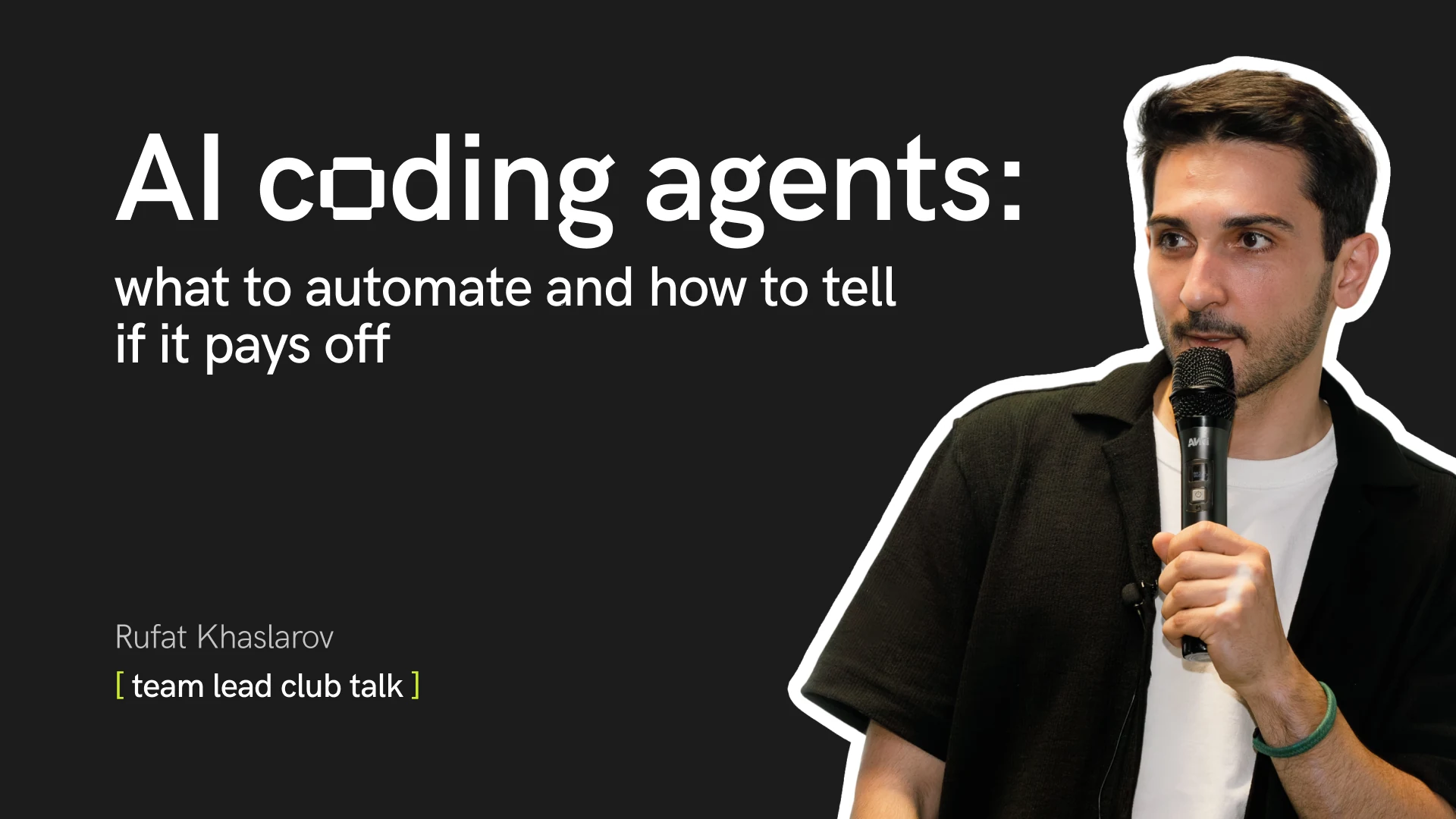
AI coding agents: what to automate and how to tell if it pays off
How to choose what to automate with AI coding agents, check the ROI and get your team to use them.


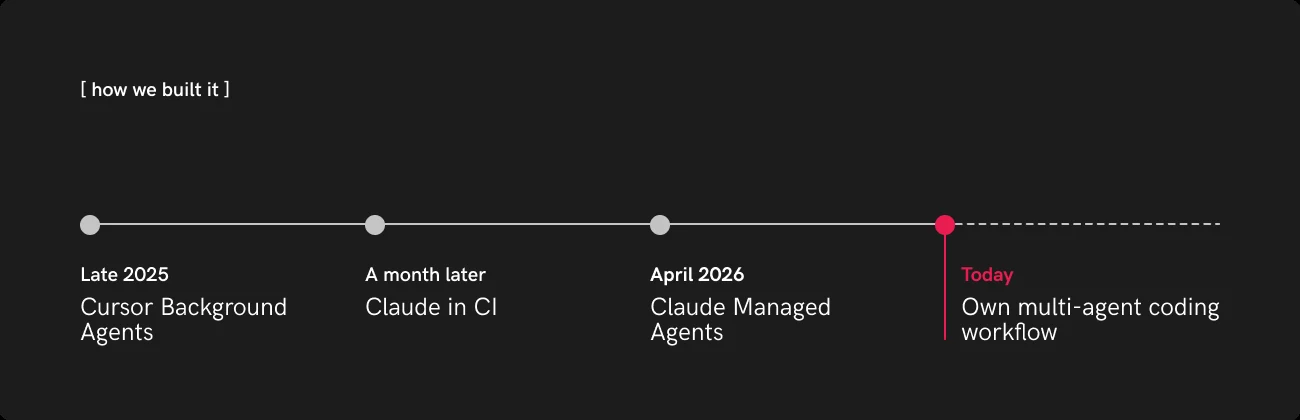
My team has been building coding agents since late 2025, and we've rebuilt our setup four times. Four times, Karl. We started with Cursor Background Agents, moved the agent into CI on Claude, tried Claude Managed Agents and ended up writing our own multi-agent coding workflow.
I've seen big agent setups that nobody uses and small, simple tools the whole team loves.
[callout]If I were architecting our multi-agent coding system again, here's what I would do first:
- decide carefully what to automate,
- check if it will pay off and what it will cost,
- define who reviews the agent's work,
- and, most importantly, make sure the team wants to use it.
[/callout]
What to automate with AI coding agents: three checks
First of all I set AI aside and ask a question: why automate this at all? In my experience, a process worth automating has to pass three checks:
- The task repeats daily and follows the same steps. Building an agent costs developer time, infrastructure, and tokens. That only pays back if the agent has work every day, which rules out anything we do once a year. Coding fits: we get small tasks and bugs daily, and each one goes through clarify, plan, code, review. If the steps change every week, the process is too unstable, and I'd leave it manual.
- Assessing the output has to cost less than producing it. If the agent writes 8,000 lines, reviewing them takes me about three days. So we cap our agent at small and medium-sized tickets, where checking is clearly cheaper than doing.
- Mistakes are easy to undo. I think about what a wrong result does and how easy it is to roll back. If the agent opens a bad PR, I just close it. If it breaks a security check that customers rely on, a rollback won't fix what they've already missed.
These checks show it's safe to automate. Whether it pays off is a different question.
How we make our AI coding agent pay off
In my experience, an agent pays off when it speeds up a big bottleneck and the next stage keeps up. To see if it's worth the effort, I check that with three old-but-gold laws:
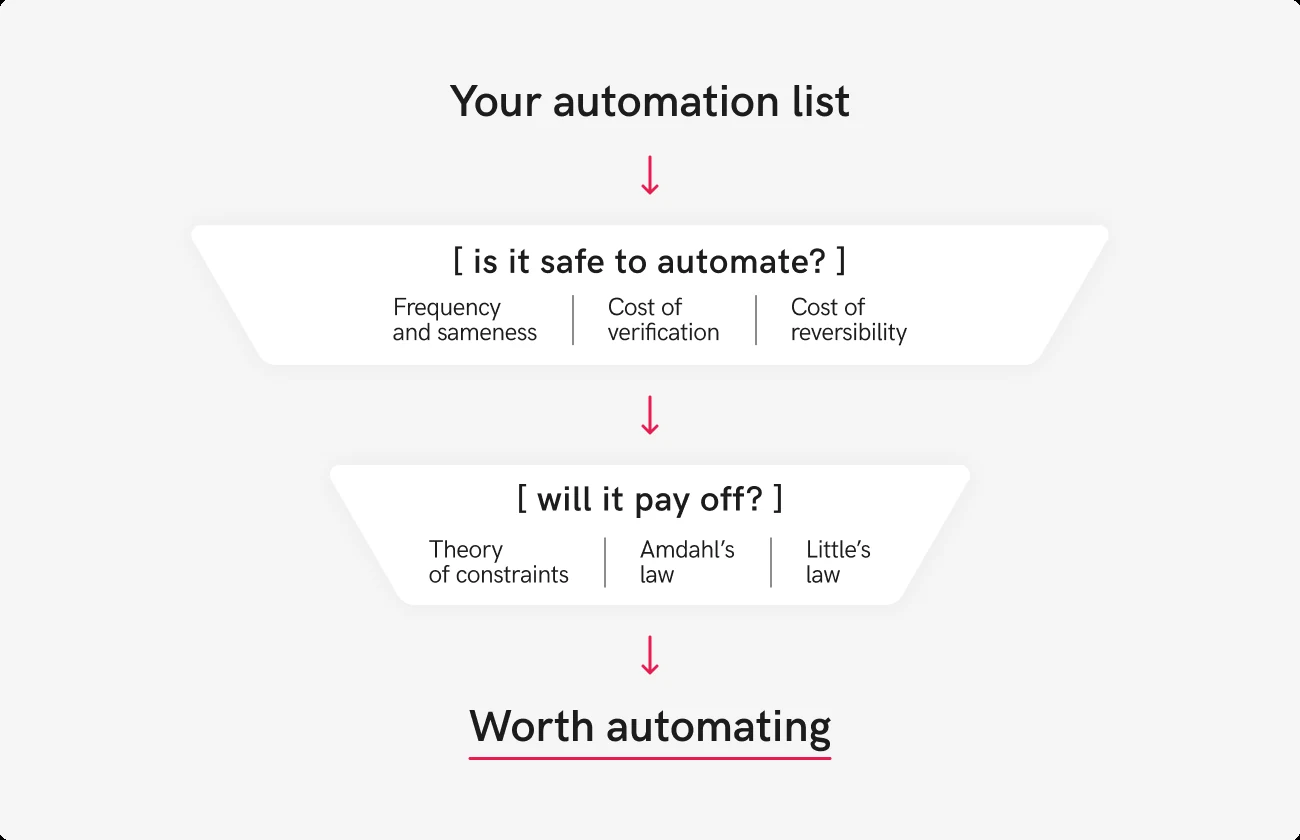
- Theory of constraints. Every process has one narrow spot that sets its speed. Speeding up any other stage won't help, so I look for the slowest one first and automate there.
- Amdahl's law. It comes from parallel computing and fits here well. If the task I automate is 20% of the process, 20% is my ceiling. That's why I pick tasks with a big share.
- Little's law. If the theory of constraints tells you where to put the agent, Little's law tells you what to fix next. If one stage speeds up, the next one can't keep up, so tasks wait longer. In our case, if the agent opens PRs faster than people can review them, the queue keeps growing. That's why code review rules come first.
We set two rules for code review.
- The agent estimates each task itself and takes only small and medium-sized tickets, so it doesn't open thousand-line PRs. Anything bigger stays with our developers.
- One developer is responsible for getting agent PRs reviewed. Notifications remind the team about open ones.
My colleague Anton Vasiljev, CTO at On The Spot Development, sees the same pattern in other teams. Developers write code faster with AI, but releases don't speed up, because the code just sits in review. He writes about what to change in reviews, specs and hiring to clear this bottleneck in how to build an AI-native engineering team.
How we got developers to use our AI coding agent
Using AI agents is often a top-down decision. Developers may not trust the agent, so they quietly work around it or ignore it. I get it. They're professionals, and they usually have good reasons to be skeptical. Often the agent simply doesn't help them.
So I wanted to build an agent that doesn't scare people and actually takes work off their hands. Here's what we did:
- We started with the most boring work. Our first target was unit tests. It's the work developers put off the most, so those tasks kept moving from sprint to sprint. Test coverage is now at 95%, most bugs are triaged automatically, and feature flags get cleaned up on their own. It sounds boring, but the agent never sleeps.
- We killed the "you'll be replaced" talk. We tell the team we're automating the routine work nobody wants, so they can spend more time on work that needs their creativity.
- We made the agent open. Our developers can open the agent's context, edit its rules, add skills and preview every PR before it's merged. A UI shows every step of each session, so anyone can see what happened. It's no longer a black box.
- We put the agent where people already work. We assign it a Jira ticket just like a human. It opens the PR, replies to review comments and responds when tagged. Developers don't have to open a CLI or dig around to figure out how to start it.
What our AI coding agent costs and delivers
Real ROI is hard to calculate, and we don't have a full formula yet. Management wants a plain number that proves the agent costs less than a person, like 100 tasks closed for $500. Developers want to see what the agent ships and get credit for it.
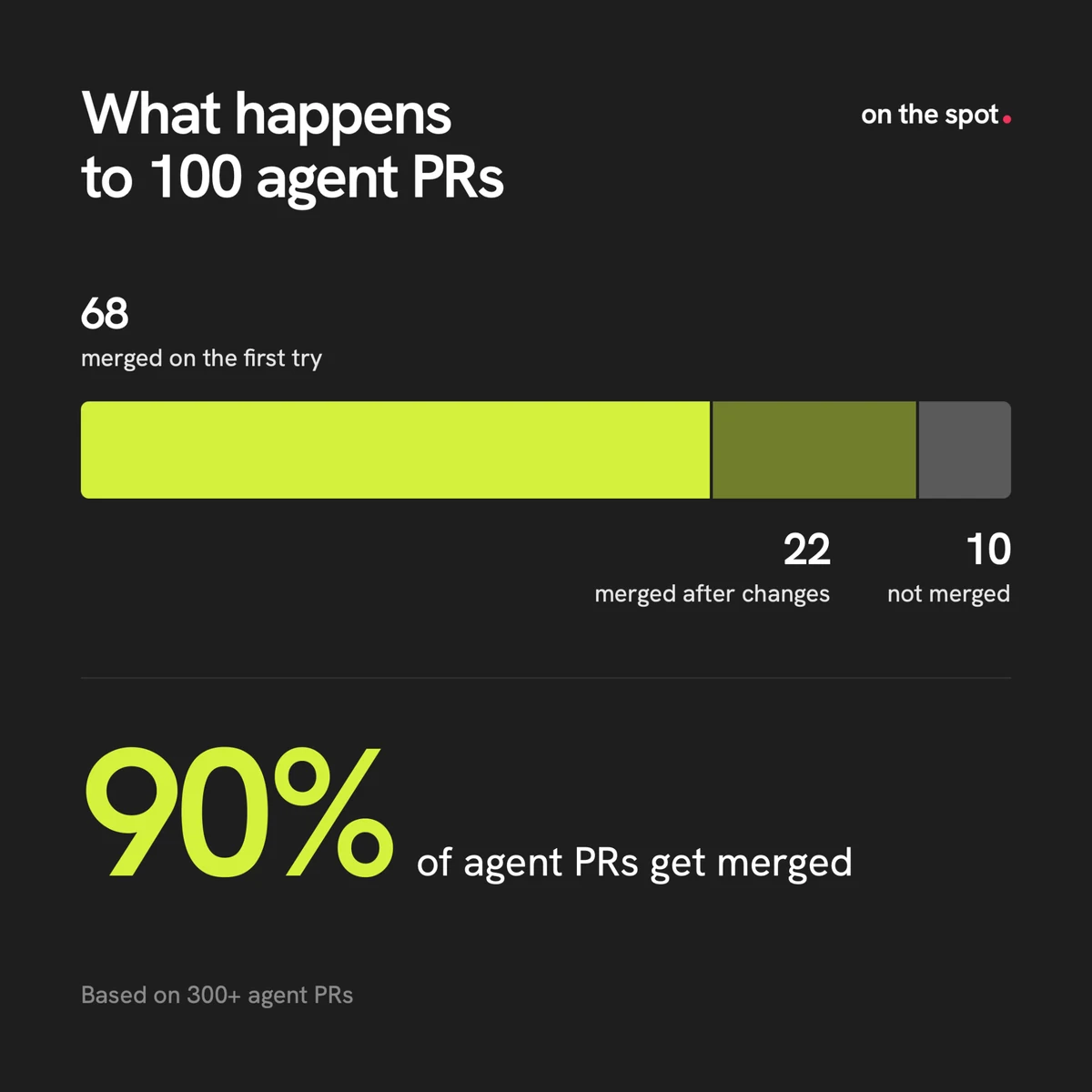
Across more than 300 PRs, our AI coding agent costs about $4 per merged pull request, including infrastructure and sandboxes, and about 90% of its PRs get merged. It takes small and medium-sized tasks and closes them four to eight times faster than a developer would. It stays cheap because we build around a deterministic core: gates stop runs that go off track. I like to joke that our agent can say "no" and ask direct questions when the requirements are unclear, just like a person would.
Another metric we track is what we call first-try merges: PRs that people approve and merge without asking for any changes. That's around 75% of merged PRs.
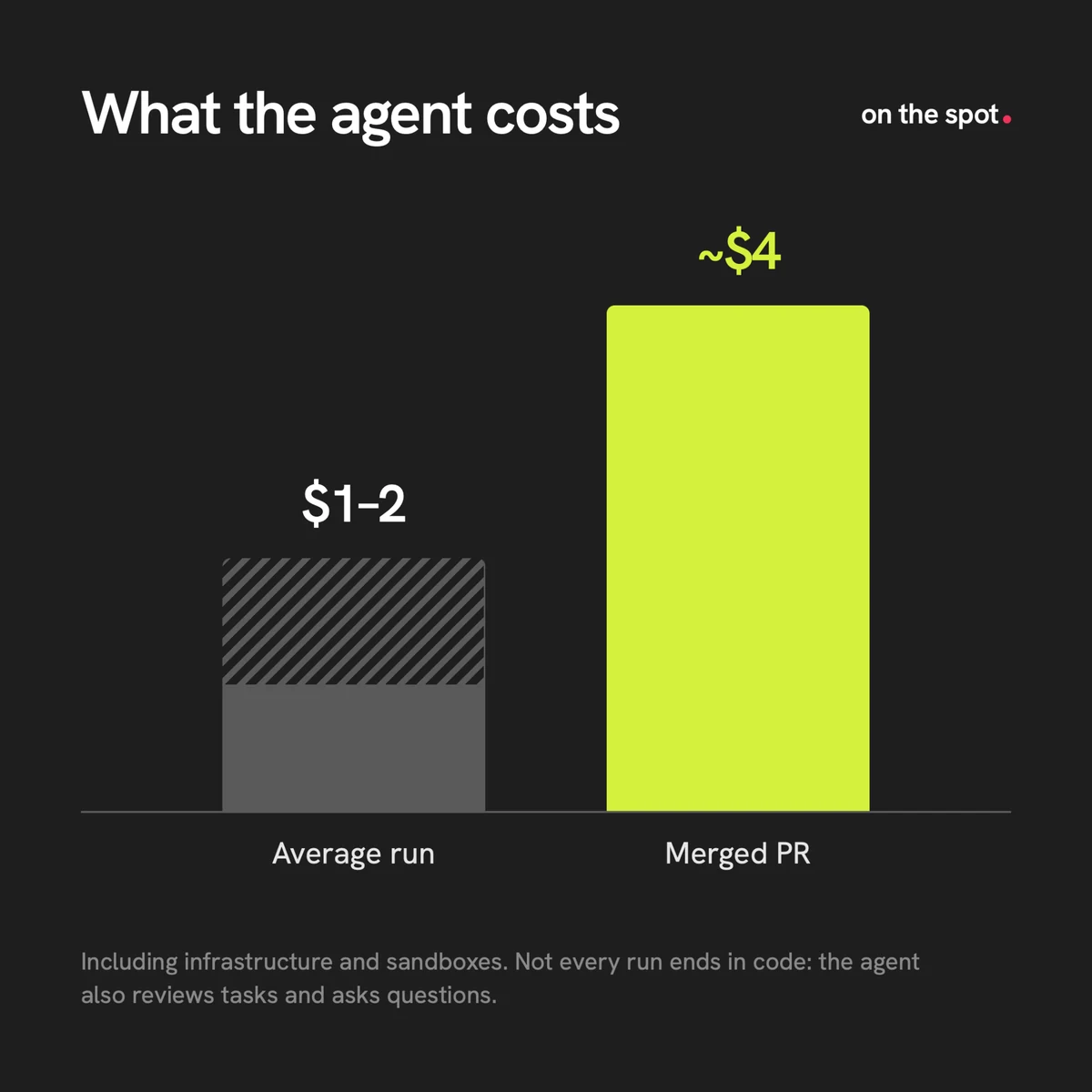
Not every run ends in code. The agent also reviews incoming tasks and can ask the reporter questions, so the average run costs less than a merged PR.
How I go through my own list
I keep a list of things I'd like to automate. Each one goes through the three checks first, then through the three laws, and I only build an agent for what's left.
I first presented this approach at Team Lead Club, a regular meeting of engineering leaders at On The Spot Development. The questions afterwards were about who reviews the agent's code and how much it costs.
[callout]If you're building a team for AI products, see how On The Spot Development hires AI developers in Poland. We also talk about agents in production at our TechSpot meetups in Warsaw: AI systems in practice, AI agents, AI agents and AppSec.
[/callout]
FAQ
[faq] Why do developers stop using AI coding agents?
In our experience, the agent doesn't make their day easier. It handles work they didn't mind doing, or starting it takes more effort than doing the task by hand. Developers also drop agents that are unstable, fail often or give poor results. [/faq]
[faq] What tasks should AI coding agents handle?
Small, frequent tasks with clear stages that are cheap to check and easy to undo. I call them operational tasks: unit tests, removing feature flags, small fixes. We cap our agent at small and medium-sized tickets, because at that size reviewing the work costs less than doing it. [/faq]
[faq] How do you measure the ROI of AI coding agents?
We don't have a full ROI formula. In the end, we measure everything in what we spend on tokens: the cost per merged PR, how many agent PRs get merged and how much faster tasks get closed. But ROI isn't only about numbers: if we free creative people to do bigger work, that's the main return. [/faq]
[faq] Why hasn't AI made our engineering team ship faster?
In our experience, the bottleneck sits somewhere else. If coding takes 20% of your delivery flow, speeding it up can't save more than 20%. And if the agent's pull requests sit unreviewed, you get a bigger review queue instead of more releases. [/faq]
[faq] Will AI coding agents replace code review?
Not in our setup yet, but we've built the infrastructure for it, and it's on our list. Right now a QA agent tests each change and writes a detailed report, and code review will work the same way. Risky changes still can't be merged without a person in the loop. It's the same pattern again: people take the complex, creative work, and agents take the operational tasks. [/faq]


Stay in tune
with On The Spot
You've successfully signed up for our newsletter. Keep an eye on your inbox.
Read more
Discover what else is happening at On The Spot

TechSpot
Tech events in Poland and online for everyone interested in software architecture and systems design. Like-minded people, top experts from leading companies, and a big engineering community.


137 Podcast
Conversations with top engineers, CTOs, and founders about day-to-day engineering and everything that excites us about tech.